A manifest is not received stock
Imported seller claims remain distinguishable from physically received units. Operators can resolve shortages and exceptions before relying on the inventory.
Know what a return is really worth.
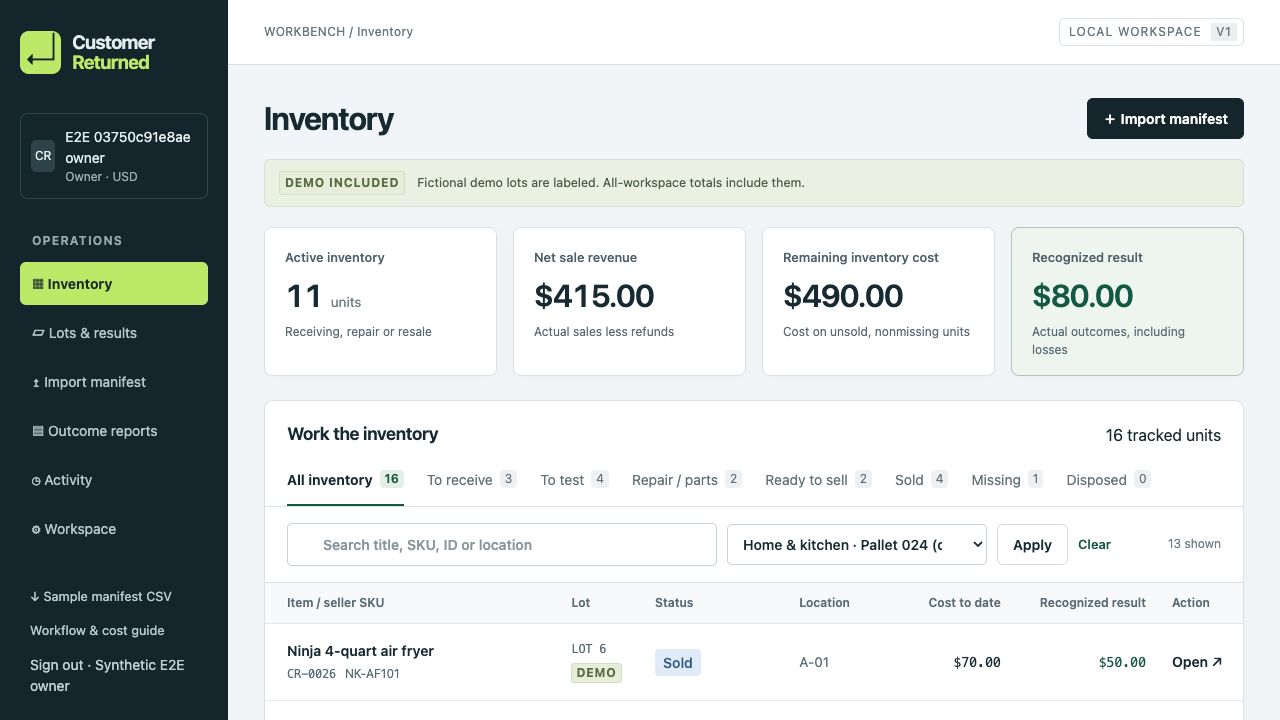
CustomerReturned is built around the messy reality of returned inventory: missing units, repairs, parts, fees, refunds, and the difference between a seller’s claim and what arrived.
A manifest is a claim, not an inventory count. Reliable decisions require physical reconciliation and costs that follow each unit through every change in its story.
The workbench connects receiving, inspection, repair, sales, and returns with integer-cent cost allocation, private photos, role boundaries, and an activity history.
Imported seller claims remain distinguishable from physically received units. Operators can resolve shortages and exceptions before relying on the inventory.
Acquisition, freight, parts, labor, selling fees and refunds are represented in integer cents. Cash recovered and trading result are separate calculations.
Returns, voided transactions and disposal are part of the model. Private photos and role boundaries support the operational record.
The inventory and accounting rules are purpose-built application code. No shared commerce or workflow package is being credited for these features.
Purchase, freight, parts and labor contribute to the invested amount using integer cents.
$i->loadMissing(['costs', 'sales.refunds', 'disposals']);
$basis = $i->purchase_cents + $i->freight_cents;
$parts = (int) $i->costs->where('kind', 'parts')->sum('amount_cents');
$labor = (int) $i->costs->where('kind', 'labor')->sum('amount_cents');
$invested = $basis + $parts + $labor;The site keeps its own copyright. SiteCredit adds the standard BWD attribution after it, using isolated styles bundled with the application.
SiteCredit package ↗<x-site-credit />A private operations application. Marketplace integrations and payment processing are outside this release.
Designed, Developed and Hosted by Better Web Design and Development Services, LLC